Hollywood’s Synthetic Star and the Erosion of Authenticity – AI For Artists
Seventh in the series AI for Aritsts by Swaptik Chowdhury for RabbleRouse News
When the Screen Actors Guild–American Federation of Television and Radio Artists (SAG-AFTRA) released a statement in September declaring that “creativity is, and should remain, human-centered,” it was not responding to a blockbuster scandal or a major studio strike. It was responding to a person who does not exist. The union’s warning came after the debut of Tilly Norwood, a photorealistic AI “actress” introduced by the London-based production company Particle 6.
Tilly Norwood is the creation of Eline van der Velden, founder of Particle 6 and its new AI talent studio, Xicoia. Van der Velden insists that Tilly is “not a replacement for a human being, but a creative work, a piece of art,” comparing her to animation or CGI, another tool in the storyteller’s arsenal. But the industry reaction was swift and unified. As reported by aimagazine, CBS News, and The Verge, actors such as Melissa Barrera, Mara Wilson, and Natasha Lyonne have condemned the idea of synthetic performers, describing it as an erasure of human connection and labor. Their frustration comes from history. SAG-AFTRA’s own protracted strike in 2023 focused on the protection of likeness rights and digital replicas. Even after winning new contractual safeguards, actors now find themselves confronting the same threat in a new guise, not a studio copying their face, but an entirely fabricated “artist” built from the composite of countless real women’s features.
Calling that art is not innovation; it is imitation
Tilly’s very existence collapses the distance between performer and product, reducing the performer’s agency to a line of code. Calling that art is not innovation; it is imitation. Van der Velden’s defense that AI is simply “a new paintbrush” follows a familiar logic of techno-optimism, the belief that new tools naturally expand creative possibility. But history shows that tools often become instruments of appropriation when power and profit dictate their use.
Many practitioners and artists have long highlighted how traditional rituals, indigenous dances, and practices like yoga and belly dance were stripped of their spiritual and communal meaning, distilled for commercial appeal, and sold back as lifestyle products. What began as a cultural expression became a marketable aesthetic. The same process is unfolding today, only faster and with data. AI “art” now extracts from vast archives of human creativity to generate profitable simulacra (representations that have become detached from any real, lived referent), turning art into a process of replication rather than creation.
An act of context
Further, art has always been an act of context. Picasso’s Les Demoiselles d’Avignon reshaped visual reality because photography had already transformed how people saw the world. The Dadaists, disillusioned by the mechanized slaughter of World War I, created works like Marcel Duchamp’s Fountain, a mass-produced urinal presented as art, to reject the logic of reason that had justified mass death. Hyperrealists such as Audrey Flack later painted simple objects with almost photographic precision, mirroring a society numbed by commercial imagery and industrial repetition.
.jpg)
Each of these movements were rooted in human experience, social, historical, and emotional. AI art, by contrast, is derivative by design. It learns statistical patterns from existing work but not the histories, choices, or ruptures that made them meaningful. When meaning itself is reduced to pattern, audiences are trained to consume images rather than interpret them. What follows is not just the automation of art, but of taste.
Assuming free choice
It is often said that the audience will decide what counts as art, letting market demand arbitrate between what is genuine and what is not. But that argument assumes free and independent choice in a world where preferences itself are engineered. Consumer preferences are not formed in isolation; they are shaped by ideological and economic structures that create both needs and aspirations.
The influencer economy and lifestyle marketing do not simply promote products; they produce ideals of beauty, authenticity, and success that people then perform. Social media feeds and entertainment platforms reinforce those ideals, making consumption feel like self-expression. The entertainment industry operates in the same way, creating tastes that legitimize its own systems of production. In such a landscape, demand is not spontaneous but cultivated. And when the production of culture itself becomes automated, AI performers like Tilly Norwood emerge not because audiences asked for them, but because the industry has already trained audiences to desire what it produces.
A different path is possible
AI can, of course, support creativity when used responsibly. Tools like AI-assisted ideation systems already help designers brainstorm concepts, leaving final judgment to the artist. The question is not whether AI should exist in creative spaces, but how it should exist, and who gets to decide that. Currently, those decisions are being made from the top down, by corporations and AI labs, without meaningful input from artists or their unions.
A different path is possible. The principles of Participatory Responsible AI, guided by the philosophy of deliberative democracy, can offer a new model for the creative industries. Deliberative democracy rests on a simple but radical idea: that diverse groups of people can come together in structured dialogue to weigh evidence, exchange perspectives, and build shared understanding before making collective decisions. It replaces token consultation with genuine participation, giving those most affected a say in shaping the systems that shape them.
We can do this
We already have tools to make this possible. Large-scale engagement exercises, such as the online deliberative poll “America in One Room”, show that ordinary citizens, when given access to good information and time to deliberate, can bridge divides and develop shared visions. Similar initiatives could bring together artists, unions, studios, and technologists to co-create not only governance frameworks, but also shared educational initiatives and workshops that build a common understanding of AI’s role in art.
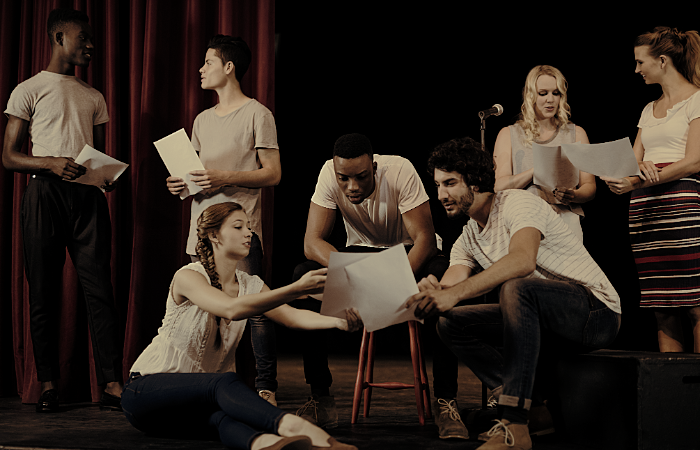
Such participatory processes would help define ethical boundaries, clarify creative use cases, and ensure that artists are active contributors rather than passive subjects in this technological transformation. Participation does not mean resisting innovation; it means ensuring innovation serves the people whose labor gives art its meaning.
Feel free to reach out
I’d love to hear your thoughts. This column is meant to be a conversation where we explore AI and its impact on artists together. Feel free to reach out to me at swaptikchowdhury16@gmail.com with your comments, questions, or suggestions for future topics. I look forward to reviewing your feedback and creating content that is helpful to you. Please note that I have used AI to assist in editing this piece, but the ideas and arguments expressed here are entirely my own and do not reflect the views of any organization or institution with which I am affiliated.
*Feature image includes modified creative commons photograph of 2A deep image of interstellar Comet 3I/ATLAS captured by the Gemini Multi-Object Spectrograph (GMOS) on Gemini South at Cerro Pachón in Chile – created by the National Optical-Infrared Astronomy Research Laboratory (NOIRLab)

Discover more from RabbleRouse News
Subscribe to get the latest posts sent to your email.