
Film Review: World Premiere of BENEATH THE ASHES
Resilience, Ruin, and the Unbreakable Roots of Altadena
Beneath the Ashes is an incredibly compelling, heartbreaking, must-see film about resiliency, community, diversity, catastrophe, and the racism that permeates our city and our nation. Directed by Hrag Ydalian and produced by Brandon D. Lamar, the documentary features a powerful array of local voices. These include community artist Keni Arts, Pastor Thomas Bereal of Abounding Grace Ministries, and Emeka Chukwurah, owner of Rhythms of the Village. The film also features former State Legislator and Pasadena Mayor Chris Holden, NAACP Pasadena Branch President Brandon D. Lamar, and Pasadena School Board Member Patrice Marshall McKenzie. Personal histories are shared by lifelong Altadena residents Dawn Moore and Rand Vance, along with Dennis Robinson and Rose Robinson, the grandson and daughter of Olympian Mack Robinson. Rounding out the participants are Jasmin Shupper, founder of the Greenline Housing Project, and John Williams, Executive Director for The Center for Restorative Justice.
A “Perfect Hellstorm” in Altadena
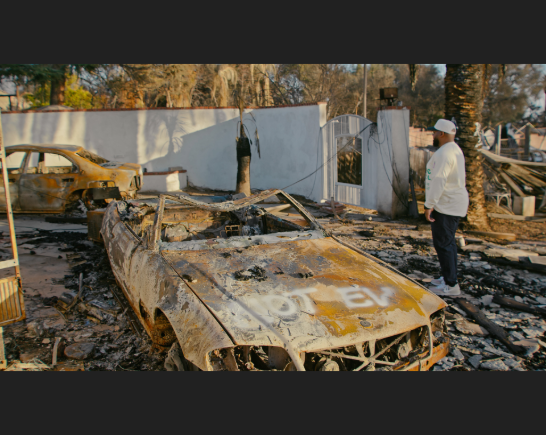
On January 7, 2025, the devastating combination of 100 mph Santa Ana “devil” winds and a raging, blazing fire caused a “perfect hellstorm,” and the diverse, historic Black community of Altadena was nearly obliterated. 9,400 structures were lost, many of which were family homes spanning generations; five public schools and 19 lives were also lost. People lost everything of material value—their homes were legacies, generational wealth passed down, and now they are nothing but ashes. The community has every hope to rebuild and regain their rich, diverse, and culturally significant neighborhood, now threatened by “developer vultures” and speculative investors looking to swoop in.
The film, with some truly powerful scenes of wind and fire, follows residents of Altadena who lost their homes of 50+ years and their businesses. As Dennis Robinson points out, while you can buy clothes and furniture, photos, heirlooms, awards, and artwork are irreplaceable. One of the most heartbreaking moments features young Josie Taylor describing her house on what is now just an empty dirt plot.

History, Redlining, and Resilience
The documentary explores the history of Altadena with archival footage. Whereas the City of Pasadena was segregated—and African Americans could only use the city pool at the end of the day before the water was drained for the white residents—Altadena became a different kind of space. The film highlights Mack Robinson (brother of Jackie Robinson), who broke a world record in the 1936 Olympics only to be beaten by Jesse Owens. There was no parade or celebration for him when he came home.
The film also addresses redlining, where color-coded maps showed areas where Black residents were not “allowed” to live. However, this paved the way for the community of Altadena (west of Lake Avenue) to become a place where Black families could find homes of their own. In the 60s and 70s, many escaping the Jim Crow South found a haven there, and it became a “hidden gem” and an “amazing community of eclectic ideas, cultures, and backgrounds”.
The Battle to Rebuild
After the fires, the community came together to help one another, but there is still so much more to be done—especially with the threat of developers. As the film notes, “Generations of blood, sweat, and tears could be wiped out if we can’t rebuild”. A local non-profit, Greenline Housing, is attempting to buy the plots if families choose to move and sell them to other Black families. However, there is hope, and the film ends on that note with Pastor Thomas Bereal observing a tree and saying, “You burned us on top, but you didn’t burn our roots… our roots are still strong underneath”.
A Critical Perspective
There is so much to this story, and I would have loved to see even more: the comparison between the Altadena fire and the Palisades fire, the perspective of local officials, and the specific details of the recovery process regarding systemic racism. The tale is incredibly sad, yet as a viewer, I felt more stunned than purely heartbroken. The residents are resilient and logical in their storytelling, which makes the film feel more informative than purely emotive. While I would have liked more “quiet moments” to let the emotion settle, a TRT (Total Running Time) of 63 minutes does not allow for much time when there is so much information to impart. Additionally, providing specific ways for viewers to help—such as organizations for donations or volunteering—would be a welcome addition.
Beneath the Ashes screened at Dances with Films LA 2026. For updates on future screenings and news about the film, visit the website BeneathTheAshes.com.

Discover more from RabbleRouse News
Subscribe to get the latest posts sent to your email.